Air-Dye Technology in Kitchen Linen Textile Products: Revolutionizing Sustainability and Performance
Share Post
Air-Dye represents a paradigm shift in textile coloration, fundamentally reengineering the dye application process by replacing water with air as the primary transport medium. This technology eliminates the aqueous dye bath that has defined textile coloration for centuries. The process begins with specialized disperse dyes printed onto recyclable paper carriers using precise digital printing technology. This paper then makes direct contact with the target fabric under carefully controlled heat and pressure conditions.
The thermodynamic process involves heating the dye carrier to approximately 200-210°C, at which point the solid dye particles undergo sublimation transitioning directly from solid to gaseous state without becoming liquid. In this vapor phase, the dye molecules exhibit heightened kinetic energy, enabling deep penetration into the textile substrate. The fabric’s molecular structure momentarily “opens” under thermal excitation, allowing gaseous dye particles to infiltrate the fiber matrix. Upon cooling, the fabric structure reforms, trapping dye molecules within rather than merely coating the surface. This molecular-level bonding creates exceptionally vibrant, durable coloration that resists fading, washing damage, and abrasion.

Unlike traditional dyeing methods that apply color to fabricated textiles, Air-Dye integrates coloration at the fiber stage before yarn formation. This distinction proves particularly significant for kitchen linens, as it ensures that cutting, sewing, and everyday abrasion don’t reveal uncolored substrate beneath. The technology’s proprietary pulse technology enhances this effect by optimizing dye penetration depth, achieving dye injection rather than surface application. This deep penetration creates fabrics with exceptional colorfastness – a critical advantage for kitchen textiles subjected to frequent washing, abrasive cleaning, and exposure to acidic foods and cleaning agents.
Kitchen textiles endure uniquely demanding conditions: repeated exposure to high temperatures, abrasive cleaning, food acids, oils, and frequent laundering. These challenges make coloration durability, structural integrity, and hygiene paramount concerns that Air- Dye technology addresses through its distinctive technical properties. The molecular bonding achieved through gaseous dye transfer creates a monolithic coloration throughout each fiber rather than surface- level application. Consequently, Air-Dyed kitchen linens maintain vibrant coloration despite hundreds of wash cycles without the “frosted” appearance that plagues traditionally dyed items when surface dye erodes, revealing undyed fibers beneath.
From a performance perspective, Air-Dye enables unprecedented design freedom for kitchen linens. The technology supports infinite color combinations without screen limitations, including photographic-quality printing and intricate patterns impossible with rotary screen printing. Particularly revolutionary is the dual-side coloration capability. Designers can specify different colors or patterns on each fabric face a burgundy floral exterior with coordinating solid burgundy interior on pot holders, or playful contrasting patterns on reversible table runners. This functionality creates new aesthetic dimensions while solving the perennial problem of “wrong-side” visibility in kitchen textiles where both surfaces remain visible during use.
Performance Comparison of Kitchen Linens:
|
Performance Characteristic |
Traditional Dyed Linens |
Air-Dyed Linens |
Advantage Impact |
|
Colorfastness to Washing |
Moderate |
Excellent |
Maintains appearance after 50+ washes |
|
Color Transfer to Foods |
Possible with poor quality |
None |
Enhanced food safety |
|
Fiber Damage During Dyeing |
Up to 10% |
Less than 1% |
Longer product lifespan |
|
Backside Appearance |
Often unfinished/white |
Designed coloration |
Reversible functionality |
|
Chemical Residues |
Likely without certification |
None |
Safer for food-contact surfaces |
The ecological advantages of Air-Dye technology establish it as a transformative solution for sustainable kitchen linen production. The most conspicuous benefit remains its dramatic water conservation. Conventional dyeing consumes approximately 170 liters of water per average kitchen towel in the dyeing process alone, while Air-Dye reduces this to under 8.5 liters a 95% reduction. When scaled to industrial production, this translates to millions of cubic meters of freshwater preserved annually. For perspective, adopting Air-Dye for kitchen linen production could save enough water annually to supply domestic needs for cities of hundreds of thousands.
Beyond water conservation, Air-Dye delivers substantial energy savings throughout the production cycle. Traditional dyeing requires maintaining massive dye baths at elevated temperatures for extended periods, followed by energy-intensive drying processes. Air- Dye consolidates dye fixation and drying into a single thermal transfer step, reducing energy consumption by 86%. This efficiency lowers the carbon footprint of dyed textiles significantly, mitigating climate impact. Additionally, eliminating wastewater treatment itself an energy-intensive process further enhances the technology’s carbon advantage.
The closed-loop nature of Air-Dye technology eliminates toxic effluent discharge. Traditional textile dyeing releases contaminated wastewater containing unfixed dyes, heavy metals, salts, and processing chemicals into waterways. Air-Dye produces zero process wastewater, preventing aquatic ecosystem contamination. Moreover, the technology requires no chemical auxiliaries like salt, fixing agents, or surfactants reducing chemical usage by approximately 90% compared to conventional dyeing. This comprehensive environmental profile positions Air-Dye as a cornerstone technology for sustainable kitchen linen manufacturing.
Implementation in Kitchen Linen Manufacturing
Integrating Air-Dye technology into kitchen textile production requires reconfiguring traditional manufacturing workflows but offers compelling operational advantages. The process begins with fabric selection, focusing on synthetic fibers like polyester that respond optimally to sublimation dyeing. Polyester’s dominance in premium kitchen linens stems from its inherent durability, wrinkle resistance, and moisture-wicking properties all enhanced through Air- Dye processing. Manufacturers source undyed greige goods, typically woven or knitted to specifications optimized for kitchen applications: terry constructions for towels, tight weaves for tablecloths, and heat- resistant blends for pot holders.
The production workflow commences with design preparation using specialized software that manages color separation and pattern alignment. Unlike rotary screen printing requiring separate screens for each color, Air-Dye handles unlimited colors digitally in a single pass. Designs print onto recyclable carrier paper using non-toxic disperse dyes precisely formulated for sublimation. Fabric and printed paper then feed continuously through a calender system with heated rollers where dwell time, temperature, and pressure are precisely controlled to optimize dye transfer. This continuous process replaces the batch-based nature of conventional dyeing, enhancing production flexibility.
A transformative advantage for kitchen linen manufacturers is Air-Dye’s elimination of minimum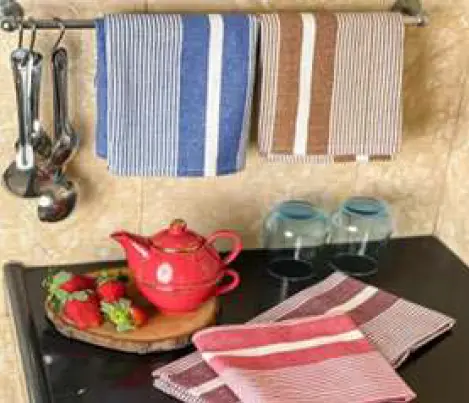 order quantities. Traditional dyeing requires massive production runs to justify screen preparation and bath formulation costs. Air-Dye enables economical short runs – even single items making customized and seasonal designs financially viable. This flexibility revolutionizes inventory management, allowing manufacturers to produce linens in response to actual demand rather than speculative forecasting. The technology’s rapid changeover capability further supports just-in-time manufacturing, reducing warehousing needs and inventory waste.
The core scientific principle enabling Air-Dye technology involves exploiting the thermoplastic behavior of synthetic fibers. When heated above their glass transition temperature, the polymer chains in synthetic fibers become mobile, creating microscopic openings for dye molecules to enter. Upon cooling, these molecular chains reorganize, trapping dye particles within the fiber structure. This produces coloration that is integral to the fiber rather than superficially applied, explaining the extraordinary wash fastness of Air-Dyed textiles.
Currently, Air-Dye achieves optimal results with synthetic fibers, especially polyester and its variants. Polyester’s hydrophobic nature, crystallinity, and molecular structure make it exceptionally receptive to sublimation dyes. For kitchen linens requiring high durability and moisture management, polyester offers advantages including dimensional stability, quick drying, and resistance to microbial growth. However, the dominance of cotton in kitchen textiles presents a significant adoption barrier, as natural cellulose fibers lack thermoplastic properties. When heated, cotton’s ring-structured cellulose molecules don’t temporarily “open”; instead, prolonged heating breaks hydrogen bonds, causing irreversible damage without facilitating dye penetration.
Innovative approaches are emerging to expand Air- Dye compatibility to natural fibers. The most promising involves genome sequencing to modify cotton’s molecular structure. By identifying and modifying specific DNA sequences governing cellulose formation, scientists aim to introduce controlled thermoplastic properties while preserving cotton’s desirable characteristics. Researchers have demonstrated this approach successfully with other natural fibers, creating varieties with enhanced fiber length, strength, and color acceptance through genetic modification. Similar efforts targeting cotton could revolutionize kitchen linen production, combining Air-Dye’s sustainability with cotton’s absorbency and tactile qualities.
Blended fabrics offer an interim solution. Polyester-cotton blends can be Air-Dyed, with polyester components accepting dye while cotton remains undyed. This produces heather effects suitable for casual kitchen textiles. Chemical modifications like fiber pre-treatment provide another pathway. Technologies involving cotton modification – which alters fiber chemistry to improve dye receptivity could potentially adapt cotton for Air- Dye compatibility. Research continues into specialized dye formulations that sublimate at lower temperatures compatible with cotton’s degradation threshold.
|
Region |
Key Regulatory Focus |
Impact on Conventional Dyeing |
Advantage to Air-Dye |
|
European Union |
Chemical restrictions |
Increased compliance costs |
Elimination of restricted substances |
|
China |
Water pollution control |
Factory closures, heavy fines |
Zero wastewater discharge compliance |
|
United States |
Producer responsibility |
End-of-life liability |
Non-toxic composition advantage |
|
India |
Liquid discharge mandates |
High-cost effluent treatment |
No liquid discharge inherently |
Global Regulatory Impact on Textile Dyeing:
Air-Dye technology exists within an evolving ecosystem of waterless dyeing solutions, each with distinct technical approaches and application suitability. Understanding these alternatives clarifies Air-Dye’s unique value proposition for kitchen linens. Supercritical CO2 dyeing represents Air-Dye’s primary competitor. This technology places fabric in pressurized vessels where CO2 becomes supercritical, acting as a dye solvent that penetrates fibers without water. While effective for synthetics, this process requires high-pressure vessels limiting design flexibility and batch sizes constraints less relevant for standardized apparel but problematic for diverse kitchen linen formats.
Other specialized waterless dyeing technologies focus on specific applications like indigo dyeing for denim using alternative environments instead of water. While revolutionary for particular sectors, their applicability to colorful kitchen linens remains limited. Biological dyeing methods offer impressive sustainability but face scalability challenges and consumer acceptance hurdles for kitchen textiles contacting food. Among these alternatives, Air-Dye’s continuous processing capability, design versatility, and compatibility with existing manufacturing infrastructure make it particularly suitable for kitchen linen applications requiring diverse designs, rapid production cycles, and flexible lot sizes.
Technological integration presents compelling opportunities. Advanced dyeing technologies achieving significant dye reduction and water savings could potentially combine with Air-Dye for enhanced resource efficiency. Digital printing integration offers another frontier, with companies developing hybrid systems incorporating Air-Dye principles with pigment- based printing for natural fibers. These convergent technologies may ultimately overcome Air-Dye’s cotton limitation while preserving its environmental advantages. For now, Air-Dye remains optimal for synthetic kitchen linens requiring high design flexibility, while alternatives better suit large batches of solid-color synthetics, and emerging biological methods represent future potential for natural fiber applications.
The evolutionary pathway for Air-Dye technology in kitchen textiles involves overcoming current limitations while expanding functionality. Natural fiber compatibility remains the paramount challenge. Beyond genetic modification approaches, promising research involves plasma pre-treatment of cotton to create surface activation without chemicals, potentially enabling Air- Dye sublimation at lower temperatures. Nanocellulose coatings represent another avenue applying thin hydrophobic layers derived from biomass onto cotton fibers to create synthetic-like dye receptivity while preserving cotton’s underlying structure. Success in these areas could make Air-Dye universal across all kitchen linen substrates within the decade.
Process intensification research focuses on further reducing Air-Dye’s environmental footprint and operational costs. Advancements in infrared heating could slash energy consumption beyond current reductions by targeting thermal energy directly at dye molecules rather than heating entire fabric webs.
Catalytic dye formulation innovations aim to lower sublimation temperatures, enabling compatibility with delicate fabric constructions and reducing energy demands further. Recyclable dye carrier systems using bio-based polymers instead of paper could eliminate carrier waste while enhancing dye transfer efficiency through engineered surface topographies.
The broader implications for kitchen linen manufacturing involve transitioning toward fully digitalized sustainable production. Integration with AI-driven design platforms will enable real-time customization consumers co- creating personalized linens via apps, with automated production commencing immediately. Blockchain implementation will provide transparent sustainability verification, documenting water savings, carbon reductions, and chemical safety from dye formulation through final product. On-demand manufacturing hubs located near major markets will exploit Air-Dye’s small- lot capability to eliminate transoceanic shipping, further reducing carbon footprints while supporting local employment.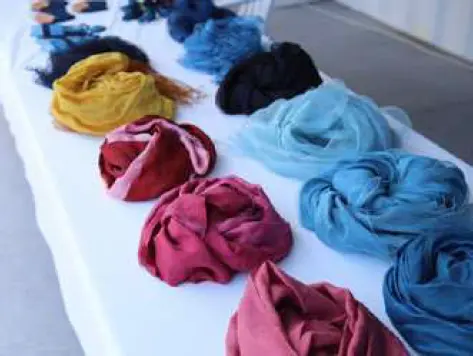
Market projections underscore Air-Dye’s growing dominance. The waterless dyeing technology market shows robust growth, with kitchen textiles representing an increasingly significant segment as consumers prioritize sustainability in frequently replaced household items. Industry leaders have initiated Air-Dye adoption for premium sustainable linen collections, with mainstream brands following as production scales and costs decrease. This trajectory suggests Air-Dye will transition from premium alternative to industry standard for kitchen textiles within 15 years, fundamentally transforming home textile sustainability.
Air-Dye technology represents far more than incremental improvement in textile dyeing; it constitutes a fundamental reimagining of coloration chemistry with profound implications for kitchen linen sustainability, performance, and design. By replacing water with air as the dye transport medium, this innovation addresses the textile industry’s most environmentally damaging process while enhancing product functionality. The 95% water reduction, 86% energy savings, and elimination of toxic effluent establish Air-Dye as an essential response to global water scarcity and pollution crises. For kitchen textiles specifically – high-use products requiring frequent washing and hygiene assurance – these environmental benefits combine with superior colorfastness, enhanced durability, and chemical safety unattainable through conventional dyeing.
The technical limitations surrounding natural fiber compatibility present significant but surmountable challenges. Ongoing research in genetic modification, fiber pre-treatment, and hybrid dye systems promises to extend Air-Dye advantages to cotton and linen – the natural Fibers traditionally preferred for kitchen applications. The economic transition, while requiring upfront investment, yields compelling operational savings and market premiums through verified sustainability. Regulatory trends worldwide increasingly favor waterless technologies, positioning Air-Dye as both environmentally and commercially imperative.
Ultimately, Air-Dye technology transforms kitchen linens from disposable commodities into sustainable design statements. The technology enables vibrant, intricate patterns and dual-surface designs previously impossible while ensuring these aesthetic creations don’t compromise environmental integrity. As consumers increasingly demand household products aligning with ecological values, Air-Dyed linens offer tangible solutions towels, aprons, and table textiles that perform better while protecting waterways and conserving resources. This powerful combination of performance, beauty, and responsibility establishes Air-Dye not merely as a novel dyeing method, but as the foundation for genuinely sustainable kitchen textile ecosystems. The technology’s continued evolution promises a future where beautiful, functional kitchen linens no longer come at the environment’s expense, redefining sustainability from Fiber to finished product.
04:48 PM, Dec 15
Source : Air-Dye Technology in Kitchen Linen Textile Products: Revolutionizing Sustainability and Performance